



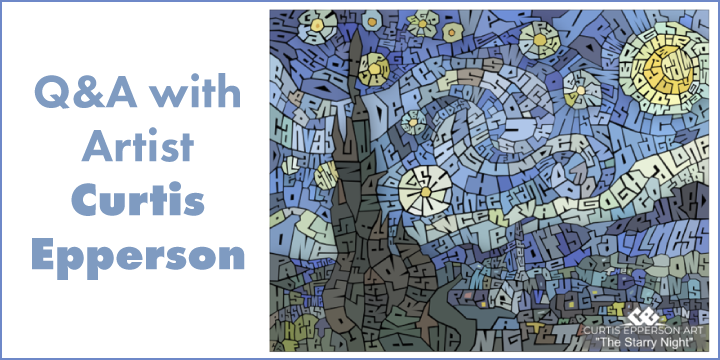
Local contemporary word mosaic artist, Curtis Epperson, transforms language into intricate visual art. His Intellectual Art for the Puzzled Mind is now on display at Orlando Public Library, giving customers an interactive experience that goes beyond the traditional confines of art.
Rather than creating with paint or traditional illustration, Epperson creates images entirely from hand-drawn words and phrases. Every single word within his art is intentional and relates directly to its subject. When viewed from a distance, the words and phrases come together to form a recognizable image. Up close, his work transforms into something entirely different: part word search, part puzzle, part education experience; inviting viewers to explore the piece and discover details they may have missed at a first glance.
We asked the artist about his inspiration and creative process, and what he hopes to communicate with those who visit Orlando Public Library and see his work.
How did you start making art? Who or what is your biggest influence?
It actually started with a trip to Disney Springs! I was walking around several years ago when I noticed a pirate skull hanging on the wall of one of the stores. It was an actual skull for decoration, not a piece of art. As I just stood there and stared, something about the teeth looked a little unusual to me. Instead of seeing teeth, my brain saw the letter “K,” because the tooth was sticking out sideways. Then I saw the capital letter “A” because there was a gap in the teeth. Before I knew it, my imagination had filled in the gaps, and I could see the word “Jack.”
That’s when I had a thought: “I wonder if I could make this entire skull out of words?” And, as they say, the rest is history!
As far as artistic influences go, I’ve always admired Thomas Kinkade. What I admire most isn’t necessarily his particular style, but the fact that he created something uniquely his own. He developed a recognizable artistic identity that became synonymous with his name. I love the idea of creating something distinctive enough that people recognize the style itself, not just the individual artwork.
Your work spans a variety of themes including wildlife, pop culture, history, and classic art. What inspires you to play with these themes?
What inspires me most is the idea of bringing three things together: art, education and puzzles. That’s really the foundation of everything I create. First and foremost, I want each piece to be a beautiful work of art that someone would be proud to display in their home or office. But when they get closer, there’s an entirely different experience waiting for them. Every word and phrase within the image relates to the subject, so there’s an educational element built right into the artwork. You might discover an interesting fact, learn something about an animal, or uncover a little piece of history you never knew. And then there’s the puzzle! I have one very important rule: I never repeat a word or phrase within a piece. That means there’s always something new to search for and discover.
To me, the subject matter is almost limitless because that combination of beauty, education and discovery can work with just about anything.
What does your process look like? What do you find most challenging in creating your pieces?
The most challenging part is figuring out exactly where each word belongs. I’m very intentional about word placement because I want the words to be part of the image in more ways than one. For example, if a word describes a subject’s eye or hair, I’ll try to incorporate that word into the actual eye or hair. I love when the meaning of the word and its placement work together. My process begins with finding a reference image. From there, I carefully research the subject, collecting words, phrases, and facts while making sure the information is accurate. Then comes what I consider the most challenging and creative part: deciding where everything should go. I pencil in the words, carefully draw each letter, add the colors, and finally put on the finishing touches that bring the entire piece together. It’s a very detailed process, but I genuinely enjoy the challenge of making all those individual words come together to create one cohesive image.
What is your favorite piece from your collection at Orlando Public Library?
Oh, that’s a tough one! I’d probably say the Eagle. Or maybe the Cougar. Although I really love the Red Panda. And the Horse. Actually, I think I’m going to have to plead the fifth on this one!
I tend to think of all my pieces as my “children,” and choosing a favorite is nearly impossible. Each one has its own personality, its own challenges, and something special about it that makes me smile.
I suppose my favorite is whichever one I happen to be looking at in the moment!
What message do you hope to communicate through your work?
More than anything, I hope people never stop discovering something new in my artwork. I love the idea of someone having one of my pieces hanging in their home or office for years, and every once in a while, stopping for just 30 seconds to take a closer look. Maybe they notice a word or phrase they’ve never spotted before. Maybe they learn something interesting about the subject. Or maybe they simply discover a little detail that makes them smile.
I don’t want my art to be something people look at once and then never really notice again. I want it to be something they can return to over and over, finding little surprises along the way. To me, that’s what makes this art form so special. It’s a beautiful picture from across the room, but up close, it’s an ongoing experience.
My greatest hope is that even years after someone brings one of my pieces home, they’ll still occasionally stop, look a little closer, and say, “Oh, I never noticed that before!”
Curtis Epperson’s art will be on display at Orlando Public Library through January 2027.


